

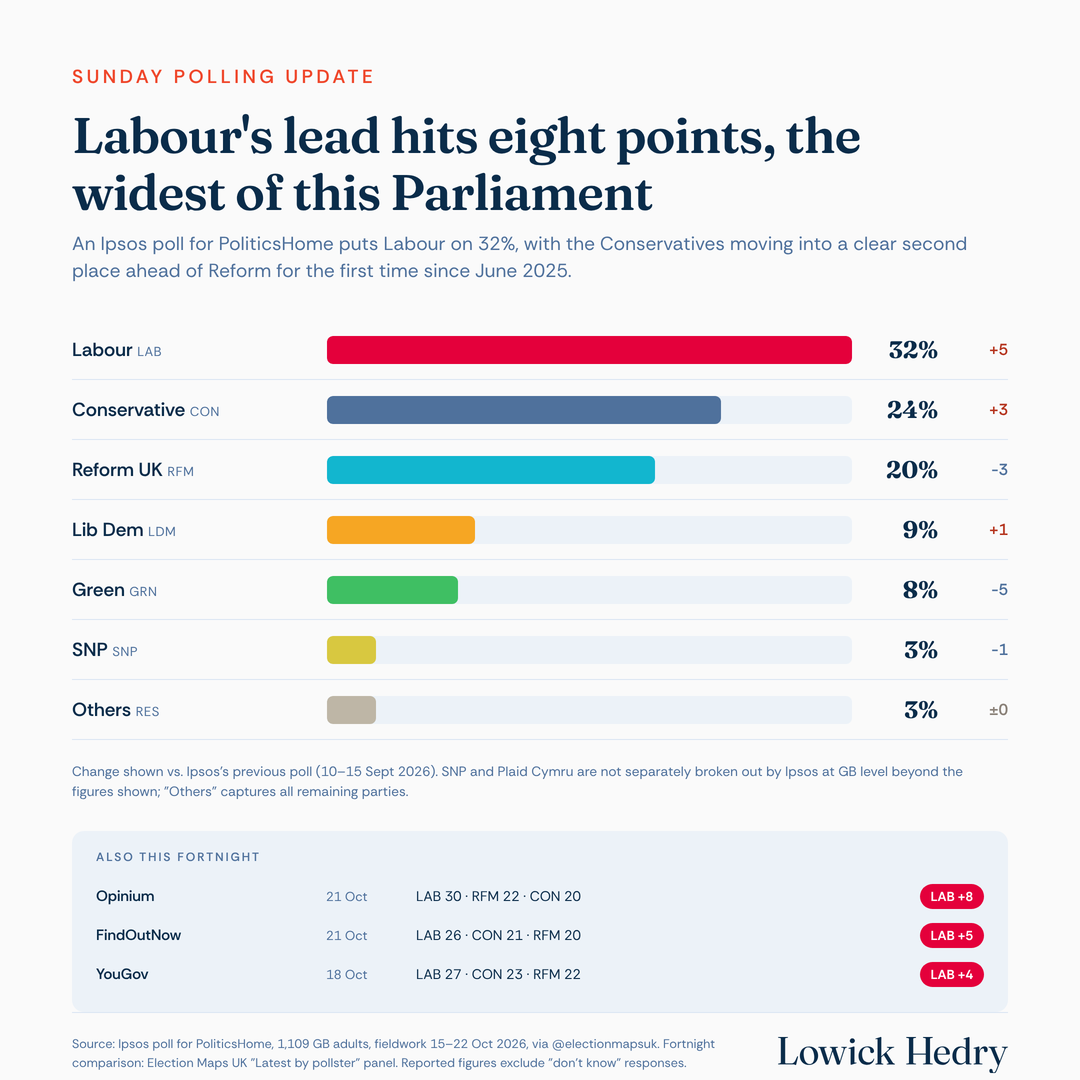
Labour’s lead over the Conservatives has hit eight points, the widest Ipsos has recorded for the party this Parliament, and Electoral Calculus’s seat model still has them winning a majority even after this week’s swing back toward the Tories.
The numbers, from an Ipsos poll for PoliticsHome (1,109 GB adults, fieldwork 15–22 October): Labour 32%, Conservatives 24%, Reform UK 20%, Liberal Democrats 9%, Greens 8%, SNP 3%, others 3%. Against Ipsos’s last reading in mid-September, that’s Labour up five, the Conservatives up three, Reform down three and the Greens down five. It’s the party’s best Ipsos lead since Andy Burnham replaced Keir Starmer as prime minister in July, and it lands a week before Chancellor John Healey’s first Budget.
It isn’t just Ipsos saying it either. Over the same fortnight, Opinium (21 October) also had Labour eight points clear, at 30% to Reform’s 22%, with the Conservatives third on 20%. FindOutNow (21 October) had Labour on 26%, a five-point lead, with the Conservatives second on 21% and Reform on 20%. YouGov (18 October) had the tightest gap, Labour on 27% to the Conservatives’ 23%, a four-point lead. The exact margin moves around by house, which is ordinary. What’s notable is that three of those four polls, Ipsos, FindOutNow and YouGov, now put the Conservatives ahead of Reform for second place. Only Opinium still has Reform there, and even that’s tight, 22 to 20.
The headline lead isn’t the only thing moving. Ipsos’s internal churn numbers show Labour losing 5% of its 2024 vote to the Greens, down from 12% a month ago, and the Conservatives losing 16% of their 2024 vote to Reform, down from 22%. Both main parties are pulling voters back from their flanks at the same time. That’s bad news for Reform in particular: it’s one thing to be squeezed by Labour, another to be squeezed by the Conservatives too, and Kemi Badenoch’s party is now back in clear second place, ahead of Reform, for the first time in an Ipsos poll since June 2025.
None of this means the government is popular. Burnham’s satisfaction rating is 35%, against 45% dissatisfied, which is underwater but still better than Badenoch (also on 35% approval) and far better than Nigel Farage, whose net satisfaction is minus 42. Ipsos’s own pollster, Keiran Pedley, put it plainly: Labour is “resurgent” under Burnham, but one poll is one poll, and British politics has not exactly been settled lately.
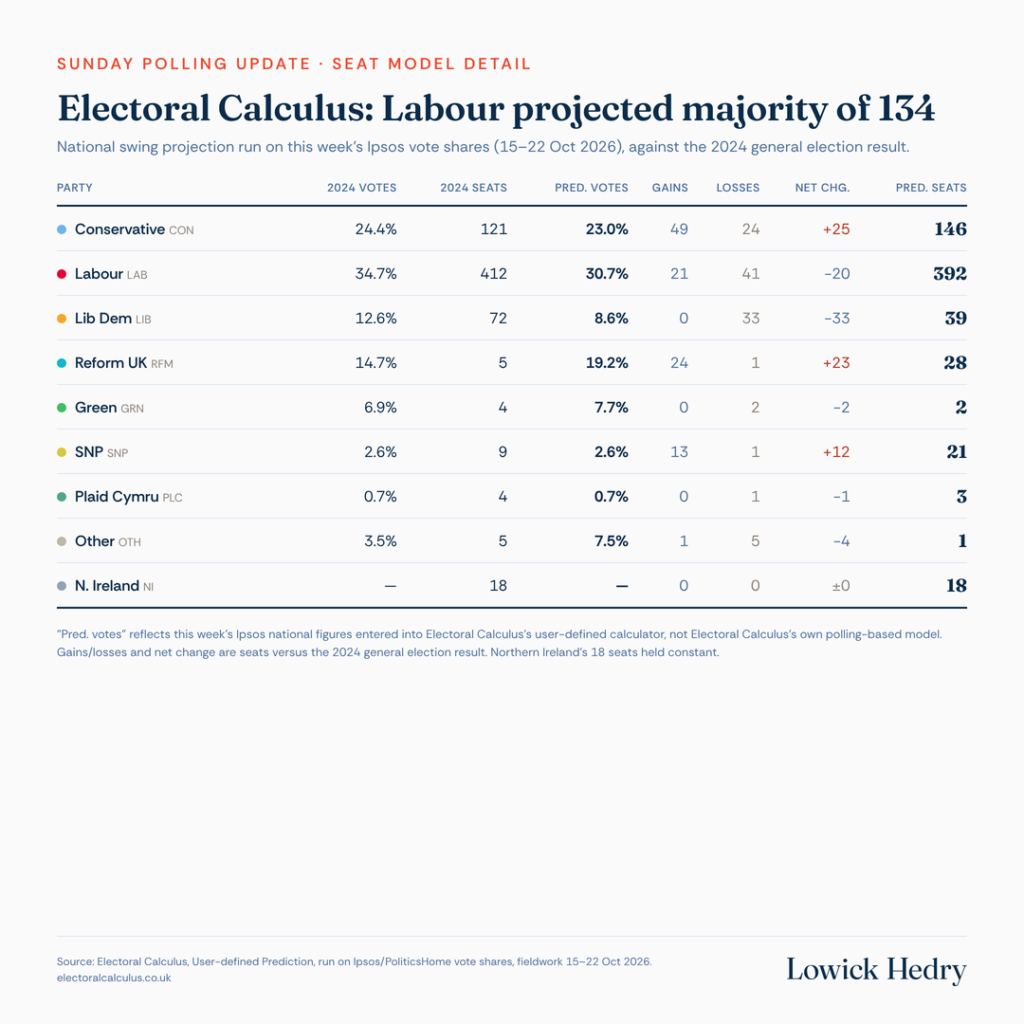
Running this week’s vote shares through Electoral Calculus’s seat calculator, Labour is projected to hold a majority of 134, a sharply reduced position from the 2024 result but still a working majority. The Conservatives more than double their seat count, from 121 to a projected 146. Reform’s seat count moves from 5 to 28, a big jump in isolation but modest given a vote share of 20%, which is what a divided right still does to a party under first past the post. The SNP picks up a dozen seats on a flat vote share, largely at the expense of other parties north of the border.
A few caveats worth holding onto. This is one poll, not a poll average, so treat the scale of the shift with some caution rather than as a settled trend. The seat figures are not Electoral Calculus’s own polling-based model, they’re its user-defined prediction tool, which takes a set of national vote shares (in this case, this week’s Ipsos numbers) and applies a uniform national swing to the 2024 result. It is a reasonable approximation, not a probabilistic forecast, and it holds Northern Ireland’s 18 seats constant rather than modelling them. Ipsos’s release does not break out Plaid Cymru separately from its GB topline, so the “others” figure above is doing more work than it looks like.
Worth remembering, as always: a good poll and a good week are not the same thing as a settled position. Burnham will take this. He shouldn’t get comfortable on the back of it.
Our view