

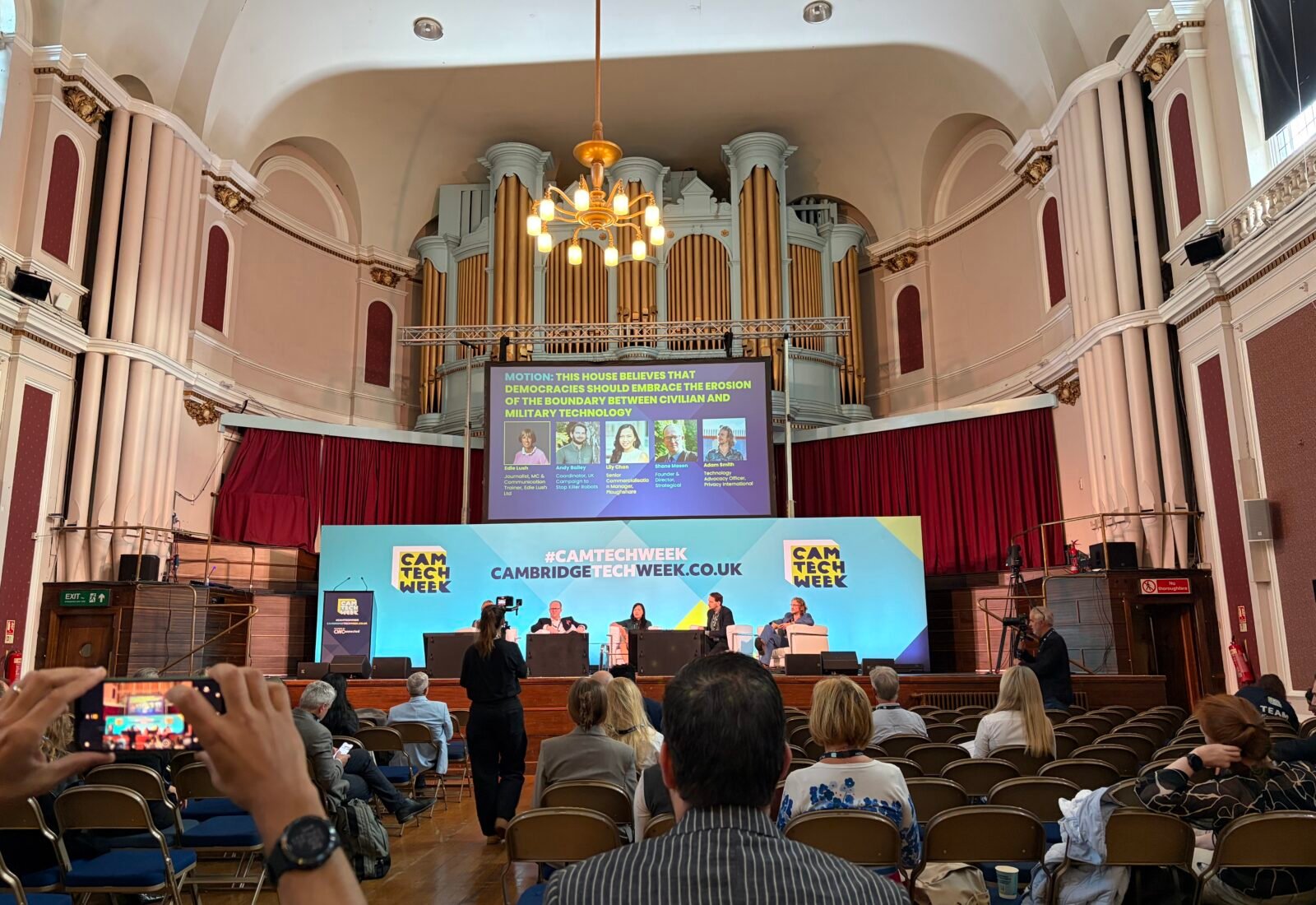
The timing couldn’t have been better for our team to attend Cambridge Tech Week. The week was set to the backdrop of Anthropic researcher Evan Hubinger’s stark warning that there’s a 10% chance of AI ‘kill[ing] all humans’ in the next ten years, and the Joint Select Committee on Human Rights’ call for a new law to address the threat to human rights posed by artificial intelligence.
The focus at Cambridge Tech Week was not, in fact, on monolithic killing machines, but on people: from what we saw, it was about the stories of scores of entrepreneurs, often working alone but with the structures that Cambridge provides in fantastic institutions like the St John’s Innovation Centre, and struggling against what must seem at times to be all the odds in order to bring their idea first to fruition, and then, eventually, and with a little help, to market.
On Day 1 of Tech Week, we learned about nascent technology emerging from the Innovation Centre: technology that interfaces between self-driving cars and CCTV to choreograph the city centre parking of future decades; a device for children afflicted by severe asthma to clear their airways whilst playing a tune; AI-powered thermostats that, if stalled in every building across the planet, have the power to cancel out the carbon cost of every flight and ship movement.
That isn’t to say that the current fear over the rapid evolution of generative AI was not filtering through, nor the associated malaise that comes with handing over more and more control to technology. The topic of the ‘Big Tech Debate’ on Thursday evening was whether democracies should embrace the erosion of the boundary between civilian and military technology: the arguments traded off the immense technological advances like the EpiPen which have stemmed from military research, against the potential for civilians to lose their lives as drone strikes become controlled by artificial intelligence.
Whilst at the outset, the audience was strongly against the proposition that we should embrace the creep of military technology into everyday life, by the end, it was 50-50. The message which we took away was one made by Lily Chan, Senior Commercialisation Manager at PloughShare, who made the point that even if we turn our backs from technological advances, they will not stop: instead, we’ll simply be on the backfoot when it comes to how this technology goes on to shape our world. We need to embrace and learn to work with new technologies, whatever their origin.
All in all, it was a fascinating week which felt like a much-needed antidote to the political and media malaise around the advances in artificial intelligence. We need to remember the incredible innovation which is ongoing every single day in Cambridge’s laboratories and science parks, and the potential that these technological advances have to truly benefit the quality of life for so many people across the world. Lowick Hedry advises some of the biggest names in the tech sector, including Google. Get in touch to talk about how we can tell your story.