

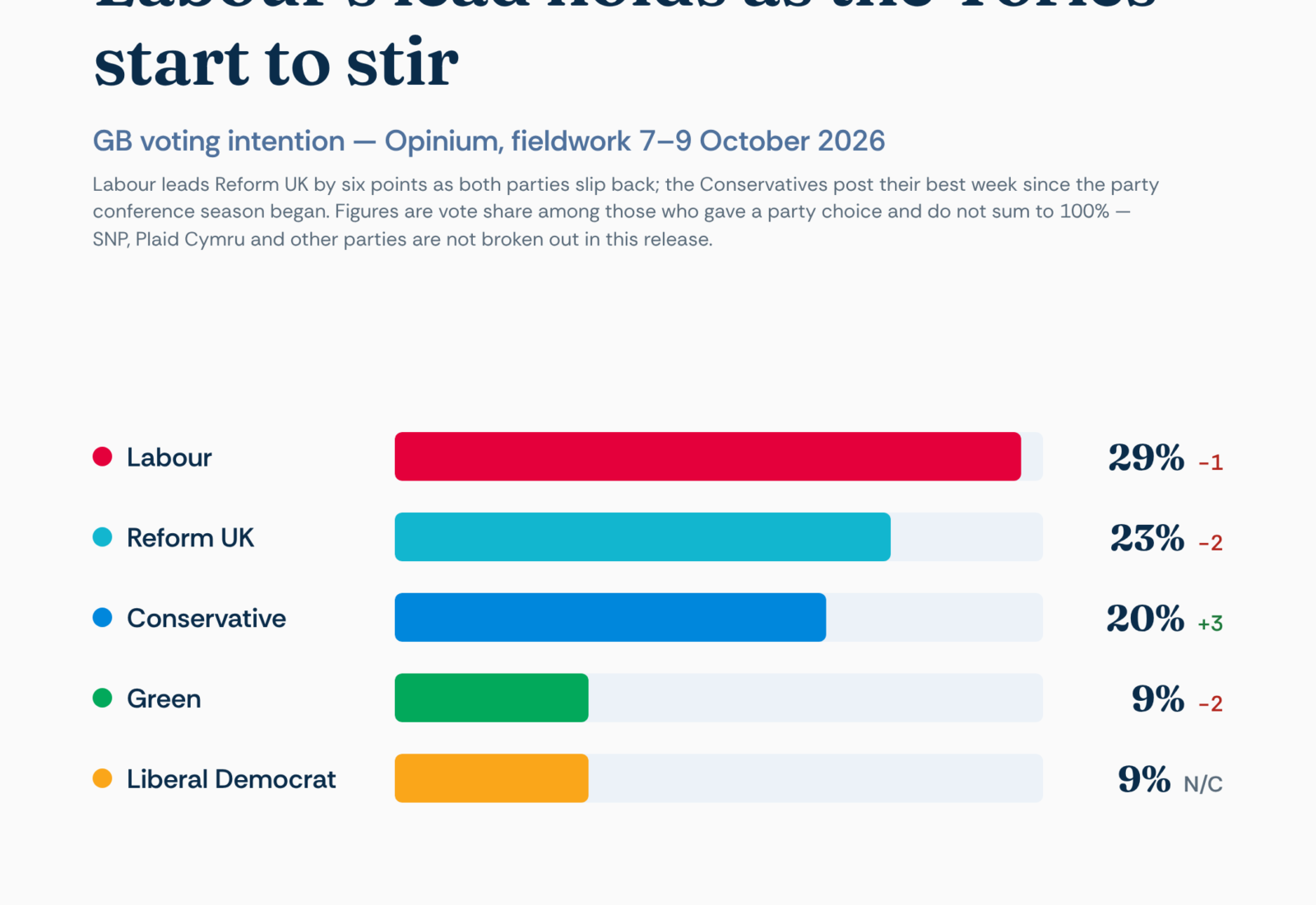
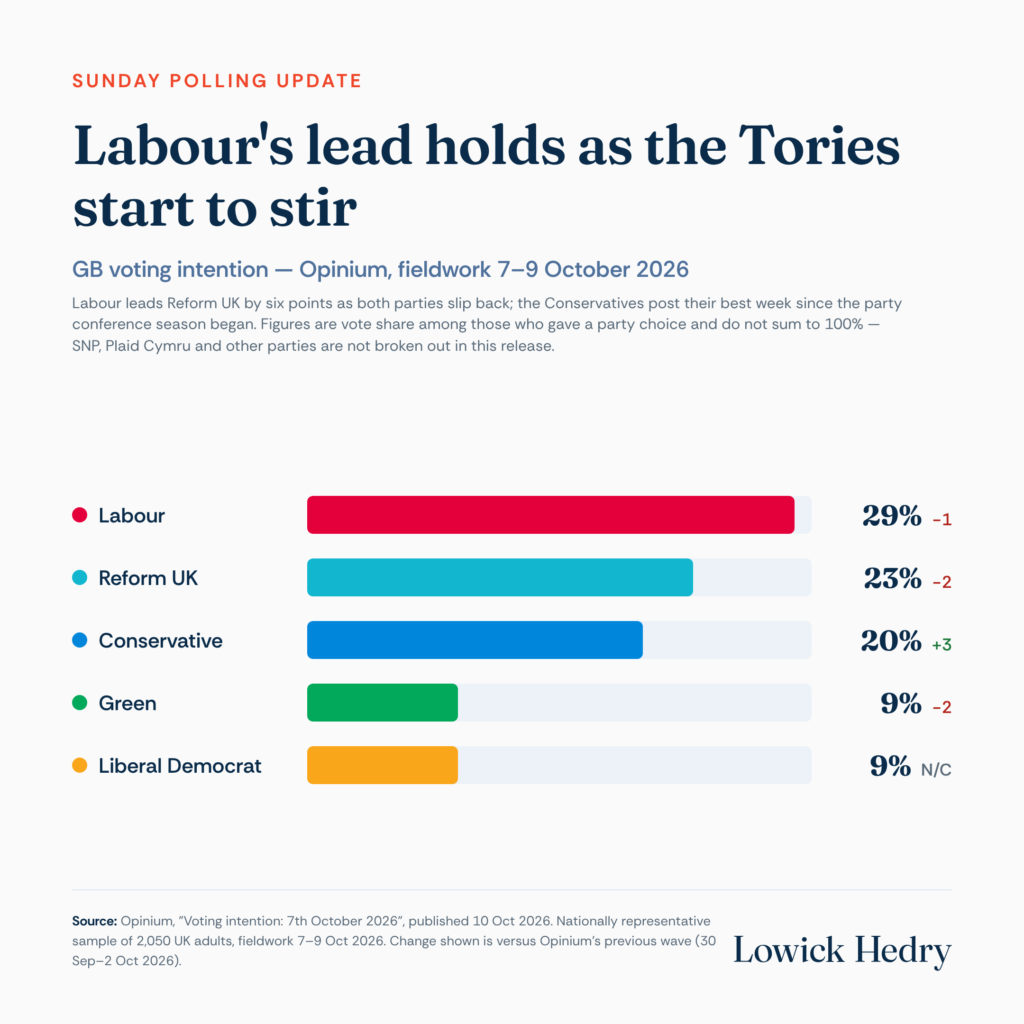
This week’s poll was fielded after conference season, and on the evidence of it, Kemi Badenoch had the better conference. The Conservatives are up three points on the back of her speech and her inheritance tax pledge. Labour came out of its own conference down a point.
That contrast is the real story, more than the topline numbers. Opinium’s release is explicit that the Conservative rise follows their party conference, Badenoch’s leadership and policy announcements are credited with “a more positive public response,” and that shows up concretely: 50% of the public back her pledge to exempt family homes from inheritance tax, against only 16% opposed. Labour had its own conference moment in the same window and got nothing from it, if anything the party lost a point. For a governing party, a conference that fails to move the dial at all is its own kind of verdict.
It sharpens an odd feature of Labour’s current position. Andy Burnham remains the only one of the five main party leaders with a positive net approval rating, +8, unchanged on the previous wave. He is, personally, the most trusted figure in British politics on this measure. None of that personal credit is translating into party support. Labour’s vote share keeps drifting down under a leader people broadly like, which points at the government’s record and its policy offer as the problem, not at who is fronting it. That is a harder problem to fix with a reshuffle or a change of tone.
Feed these vote shares into Election Maps UK’s Nowcast model and the structural consequence is stark: Labour’s majority falls to just 20 seats, down 76 on where the party sits in the current Parliament. Still a majority, but a fraction of the cushion Labour has had since 2024, and a better guide to how exposed this government now is than the six point lead over Reform suggests on its own. Labour is projected to win 335 seats, the Conservatives 101 (down 20), Reform UK 63 (up 58), the Liberal Democrats 61 (down 11), and the SNP 45 (up 36). Plaid Cymru, the Greens, the Workers Party and Restore UK pick up the remainder between them.
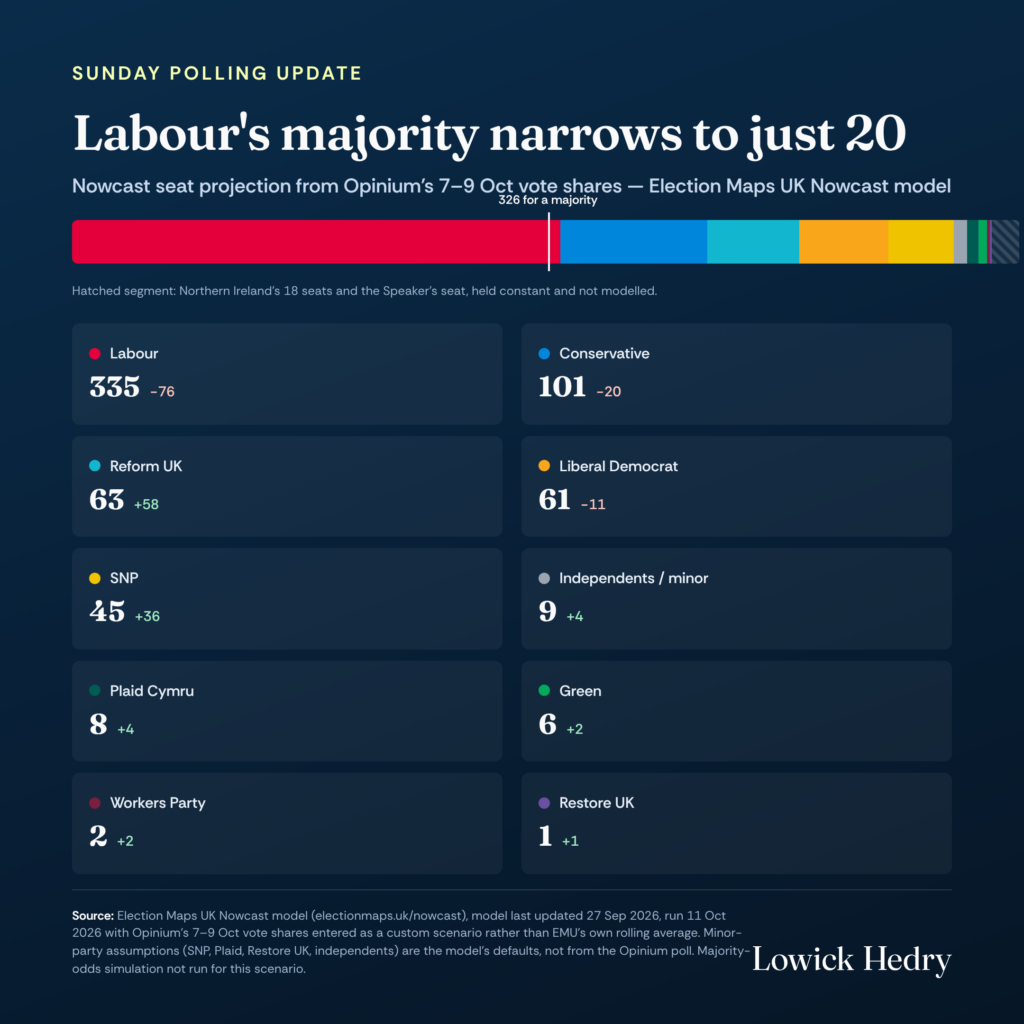
The seat changes tell a sharper story than the vote share alone, and they cut against the conference narrative in an interesting way. Reform’s jump, from 5 seats to 63, comes almost entirely from Conservative and Labour losses rather than any rise in Reform’s own support, which actually fell two points this wave to 23%. Badenoch had the better conference and her party still loses seats, because first past the post rewards where support is concentrated over where it is merely recovering, and right now that concentration still favours Reform in the seats that matter. A good week in the polls and a bad week in the model can both be true at once.
Underneath all of this, the vote share picture is one of two larger parties losing a little ground and nobody capitalising cleanly. Labour and the Conservatives between them now have their highest combined vote share in almost two years, according to Opinium’s own analysis, which is as much a comment on the state of the smaller parties as a vote of confidence in the big two.
It has also been a difficult week for the Greens, separate from the conference story. The party’s conference decision to formally describe itself as anti-Zionist has pushed public perception of a Green antisemitism problem up sharply, and leader Zack Polanski’s net approval has fallen seven points to -29, the worst rating of any of the five main party leaders, coming on the back of the party’s by-election loss in Holborn and St Pancras. Nigel Farage is next least popular at -26.
We’ll be back to our normal live sourcing, EMU’s rolling average and full Nowcast run, next Sunday.
Sources
- Opinium, “Voting intention: 7th October 2026”, published 10 October 2026. Accessed 11 October 2026.
- Fieldwork: nationally and politically representative sample of 2,050 UK adults aged 18+, 7-9 October 2026. Change figures are versus Opinium’s previous wave (30 September-2 October 2026).
- Election Maps UK, Nowcast seat projection model, model last updated 27 September 2026. Seat projection run as a custom scenario using Opinium’s 7-9 October vote shares as model inputs, rather than EMU’s own rolling GB Polling Average. Northern Ireland’s 18 seats and the Speaker’s seat held constant and not modelled; minor-party vote shares are the model’s own defaults.
Our view